Introduction: Why Secure Government Email Systems Matter
Email remains the primary communication backbone for government departments, enabling daily coordination, policy execution, and information exchange with internal and external stakeholders. However, the growing reliance on digital communication has also made email systems a prime target for cyber-attacks, including phishing, malware distribution, ransomware, and data leakage.
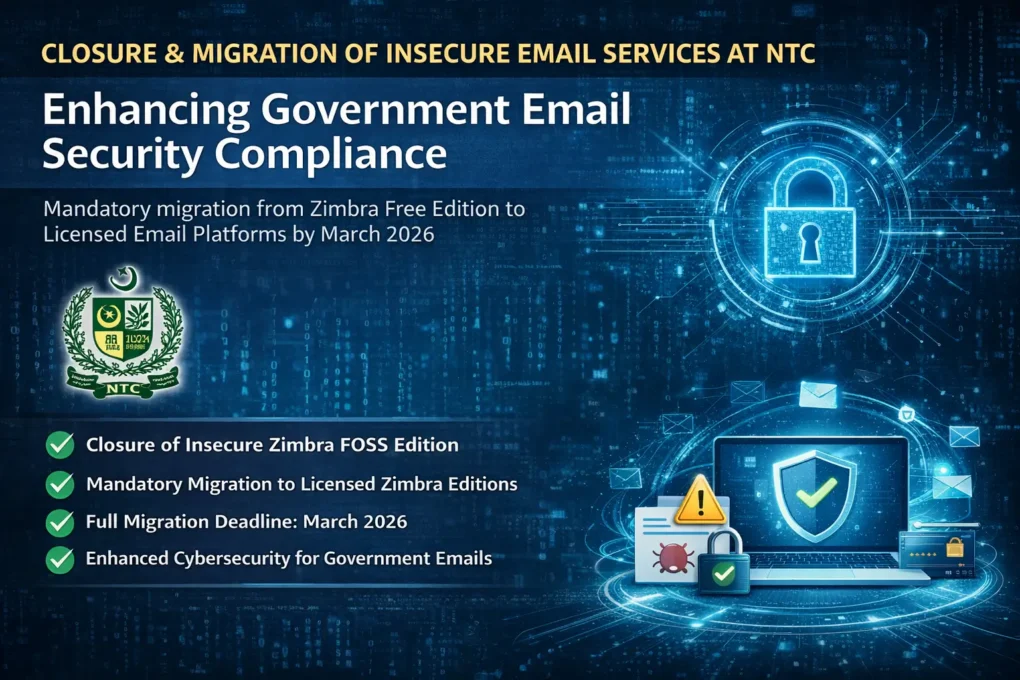
In light of increasing cybersecurity threats, the National Telecommunication Corporation (NTC), in coordination with nCERT, has emphasized the urgent need for the closure and migration of insecure email services currently operating on unsupported platforms.
Background: NTC Email Services & Zimbra FOSS Risk
As per NTC letter No. CISO 54-08/E-MAIL/2025-26 dated 01st October 2025, many public sector organizations are still using email services hosted at the NTC data centre on the Zimbra Free Open-Source Software (FOSS) edition.
While Zimbra FOSS initially provided a cost-effective solution, vendor support for the FOSS edition was officially suspended in December 2023. Since then, NTC has migrated its core services to licensed Zimbra editions and has repeatedly requested client organizations to do the same. Unfortunately, the overall migration progress remains critically low.
Why Zimbra FOSS Is a Serious Cybersecurity Threat
The Zimbra FOSS edition is now considered high-risk due to:
- ❌ No vendor security updates or patches
- ❌ Unpatched vulnerabilities
- ❌ Increased exposure to cyber-attacks
- ❌ Higher risk of data breaches and unauthorized access
- ❌ Non-compliance with national cybersecurity frameworks
These weaknesses directly threaten the confidentiality, integrity, and availability (CIA) of official government communications.
nCERT Advisory: Mandatory Email Security Compliance
In view of the above risks, nCERT strongly recommends the following measures to strengthen government email security and ensure compliance with national cybersecurity standards:
1. Use of Official Email Only
All government officials must use official email addresses for official correspondence. Personal or unofficial email services pose serious security and compliance risks.
2. Migration to Licensed Zimbra Editions
All public sector organizations must migrate from Zimbra FOSS to the latest supported and fully licensed Zimbra editions, such as:
- Zimbra Network Edition
- Zimbra Professional Edition (or higher)
All recommended security features, encryption, and monitoring controls must be enabled.
3. Migration Deadline – March 2026
All concerned organizations are required to complete migration to a licensed, supported, and fully patched Zimbra edition on or before the last week of March 2026, ensuring alignment with:
- National cybersecurity policies
- Government IT security standards
- Data protection and compliance requirements
Key Benefits of Migrating to Licensed Email Solutions
Migrating to a licensed and supported email platform offers:
- ✅ Enhanced email security & threat protection
- ✅ Regular vendor security patches
- ✅ Improved data confidentiality & integrity
- ✅ Compliance with government cybersecurity mandates
- ✅ Reduced risk of phishing, malware, and ransomware attacks
- ✅ Centralized monitoring and incident response
Conclusion: Secure Email Is No Longer Optional
The closure of insecure email services and timely migration to licensed platforms is not merely a technical upgrade, but a national cybersecurity necessity. Delays in migration expose government data to serious threats and weaken institutional trust.
All public sector organizations must treat this initiative as a high-priority cybersecurity compliance action and ensure full migration well before the March 2026 deadline.
Power SEO Keywords Used
Secure Government Email
NTC Email Migration
Zimbra FOSS Security Risks
Cybersecurity Compliance Pakistan
nCERT Advisory
Email Security for Government
Licensed Zimbra Edition
Data Protection Government IT
Phishing and Malware Protection
Public Sector Cybersecurity
Leave a Reply