ChatGPT for Business: Why Every IT Company Should Be Using AI in 2026/ Imagine completing hours of work in just a few minutes. Picture a customer receiving instant support 24/7, developers writing cleaner code faster, marketers creating high-quality content effortlessly, and businesses making smarter decisions with AI-powered insights.
This is no longer a vision of the future—it is happening today with ChatGPT.
Since its launch, ChatGPT has transformed the way businesses communicate, create, and innovate. From startups to multinational enterprises, organizations across industries are embracing AI to improve productivity, reduce costs, and deliver better customer experiences.
Whether you’re an entrepreneur, IT professional, software developer, marketer, or business owner, understanding how ChatGPT works and how it can support your daily operations can give you a significant competitive advantage.
In this comprehensive guide, we’ll explore what ChatGPT is, how it works, why it has become one of the world’s most valuable AI tools, and how businesses can use it to accelerate growth in 2026 and beyond.
What Is ChatGPT?
ChatGPT is an advanced conversational AI developed by OpenAI. It uses powerful language models to understand natural language, answer questions, generate text, write code, summarize information, brainstorm ideas, and assist users with countless professional and personal tasks.
Unlike traditional chatbots that rely on fixed responses, ChatGPT understands context and generates intelligent, human-like replies. This makes it a versatile assistant for communication, research, software development, content creation, customer service, and business operations. To learn basics of ChatGPT you can read this (Article) also.
Why Businesses Are Rapidly Adopting ChatGPT
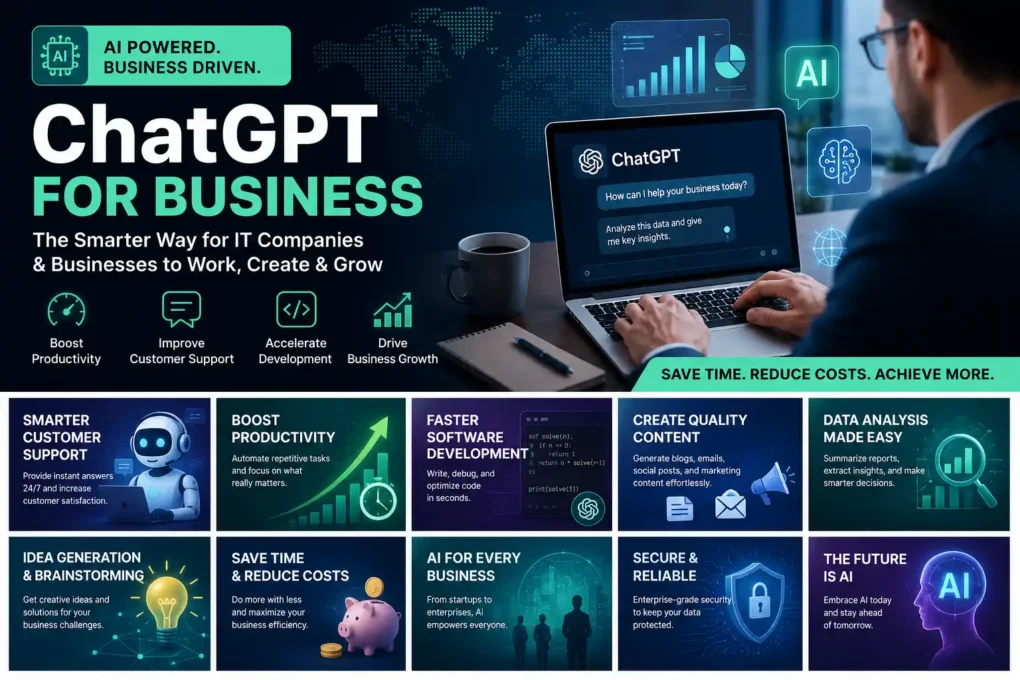
Artificial intelligence has moved beyond being a futuristic concept—it has become a practical business tool. Companies are adopting ChatGPT because it helps teams:
- Save valuable time by automating repetitive tasks.
- Improve productivity across departments.
- Enhance customer satisfaction with faster responses.
- Generate ideas and content more efficiently.
- Support software development and technical documentation.
- Analyze information and simplify complex workflows.
Businesses that integrate AI into their operations often discover new ways to improve efficiency while allowing employees to focus on higher-value work.
Top Benefits of ChatGPT for IT Companies
1. Accelerated Software Development
Developers can use ChatGPT to:
- Explain programming concepts.
- Generate code snippets.
- Debug errors.
- Create documentation.
- Suggest best practices.
- Review existing code.
Rather than replacing developers, ChatGPT acts as an intelligent assistant that speeds up development and reduces repetitive work.
2. Smarter Technical Documentation
Creating technical documentation often consumes valuable development time.
ChatGPT can assist in preparing:
- API documentation
- User manuals
- Installation guides
- Knowledge bases
- SOPs
- Release notes
This allows IT teams to maintain consistent, well-structured documentation.
3. Enhanced Customer Support
Businesses can provide faster customer service by using AI to:
- Answer common questions.
- Guide users through troubleshooting.
- Generate support responses.
- Draft professional emails.
- Reduce response times.
Human agents can then focus on more complex customer issues.
4. Improved Cybersecurity Awareness
Although ChatGPT should not replace professional security tools, it can help organizations by:
- Explaining security concepts.
- Creating cybersecurity awareness content.
- Drafting security policies.
- Summarizing vulnerability reports.
- Assisting with compliance documentation.
5. Faster Business Communication
Professionals use ChatGPT daily to create:
- Business emails
- Meeting summaries
- Project proposals
- Client presentations
- Reports
- Internal documentation
Instead of starting from scratch, employees can begin with AI-assisted drafts and refine them as needed.
How ChatGPT Benefits Different Business Departments
Human Resources
HR teams can create:
- Job descriptions
- Interview questions
- Employee onboarding guides
- Performance review templates
- Company policies
Marketing Teams
Marketing professionals use ChatGPT to generate:
- Blog ideas
- Product descriptions
- Social media posts
- Email campaigns
- SEO-friendly content
- Advertising copy
It serves as a creative assistant while maintaining the need for human review and brand consistency.
Sales Teams
Sales professionals benefit by creating:
- Personalized outreach emails
- Sales scripts
- Proposal drafts
- Follow-up messages
- Customer communication templates
Project Managers
Project managers can use ChatGPT to:
- Create project plans.
- Summarize meetings.
- Develop risk registers.
- Draft stakeholder updates.
- Organize documentation.
Real-World Business Applications
Businesses worldwide use ChatGPT for:
- Customer support automation
- Internal knowledge management
- Software development assistance
- Business process documentation
- Content marketing
- Research and analysis
- Training materials
- Data summarization
- Workflow optimization
- Team collaboration
ChatGPT for Small Businesses
Small businesses often have limited budgets and resources. ChatGPT helps them compete by enabling them to:
- Create professional marketing content.
- Draft legal and business documents.
- Build customer FAQs.
- Improve communication.
- Generate business ideas.
- Save time on administrative tasks.
AI can help small teams accomplish more without significantly increasing costs.
ChatGPT in Software Development
Software engineers frequently use ChatGPT to:
- Explain unfamiliar code.
- Learn new programming languages.
- Generate unit tests.
- Convert code between languages.
- Optimize algorithms.
- Write SQL queries.
- Debug applications.
- Produce documentation.
It acts as a collaborative coding assistant, supporting developers throughout the software lifecycle.
Improving Productivity with AI
One of ChatGPT’s greatest strengths is its ability to reduce repetitive work. Employees can spend less time on routine writing and more time on strategic thinking, problem-solving, and innovation.
Examples include:
- Summarizing lengthy reports.
- Organizing meeting notes.
- Drafting presentations.
- Creating training documents.
- Brainstorming solutions.
This can lead to better time management and increased operational efficiency.
Best Practices for Using ChatGPT in Business
To maximize value:
- Review AI-generated content before publishing.
- Avoid sharing confidential or sensitive information unless your organization’s policies and tools are designed for that purpose.
- Use clear prompts to obtain more relevant results.
- Combine AI assistance with human expertise.
- Continuously evaluate AI outputs for accuracy and quality.
AI works best when it supports human decision-making rather than replacing it.
Common Myths About ChatGPT
Myth 1: ChatGPT Will Replace Every Employee
Reality: AI automates certain tasks, but human judgment, creativity, leadership, and expertise remain essential.
Myth 2: AI Is Only for Large Companies
Reality: Businesses of all sizes—from startups to global enterprises—can benefit from AI.
Myth 3: ChatGPT Always Knows Everything
Reality: AI can make mistakes. Users should verify important information, especially in technical, legal, financial, or medical contexts.
The Future of AI in Business
Artificial intelligence is expected to become even more integrated into everyday business operations. Future developments may include:
- More personalized AI assistants.
- Enhanced collaboration tools.
- Improved business analytics.
- Smarter automation.
- Advanced enterprise AI integrations.
Organizations that invest in AI literacy today will be better positioned to adapt to tomorrow’s technological landscape.
Why PK-360 Recommends ChatGPT
At PK-360, we believe ChatGPT is one of the most valuable AI tools available for modern businesses. Its ability to support productivity, software development, customer engagement, and content creation makes it a practical addition to many professional workflows.
However, successful adoption depends on responsible use, ongoing human oversight, and thoughtful integration into existing business processes.
Frequently Asked Questions
Is ChatGPT suitable for small businesses?
Yes. Small businesses can use ChatGPT to streamline communication, create marketing content, draft documents, and improve customer service while saving time.
Can ChatGPT help software developers?
Yes. It can assist with coding, debugging, documentation, testing, and learning new programming concepts. Developers should still review and validate all AI-generated code.
Is ChatGPT free?
ChatGPT offers both free and paid plans. Available features and capabilities vary depending on the plan selected.
Can ChatGPT replace customer support agents?
It can automate responses to common inquiries, but complex customer issues often require human support.
Is ChatGPT safe for businesses?
It can be used responsibly within organizational policies. Businesses should avoid entering confidential or sensitive information into AI systems unless appropriate safeguards are in place.
Final Thoughts
ChatGPT is reshaping the way businesses operate by helping teams work more efficiently, communicate more effectively, and solve problems faster. For IT companies, software developers, marketers, entrepreneurs, and business leaders, it offers a practical way to enhance productivity and support innovation.
As AI continues to evolve, the organizations that embrace it thoughtfully—while maintaining human oversight and critical thinking—will be better equipped to thrive in an increasingly digital world.
Whether you’re just beginning your AI journey or looking to optimize existing workflows, ChatGPT can be a valuable partner in achieving your business goals.
About the Author
Haider Ali is the Founder of PK-360 and an IT professional with over 16 years of experience in IT solutions, networking, software development, cloud technologies, and cybersecurity. He shares practical insights, software reviews, and AI guidance to help businesses and professionals make informed technology decisions.