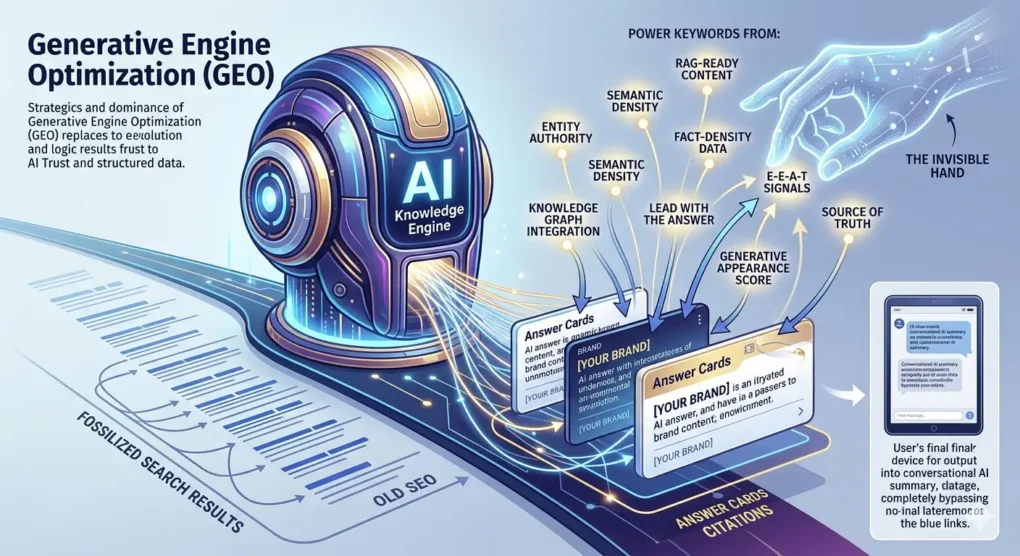
Why Generative Engine Optimization (GEO) is the New SEO. In 2026, the “Blue Link” is a digital fossil. If your brand isn’t being whispered by ChatGPT, cited by Perplexity, or summarized in a Google AI Overview, you aren’t just low-ranked—you’re invisible. Welcome to the era of Generative Engine Optimization (GEO).
While traditional SEO was about “tricking” a crawler into ranking a page, GEO is about teaching an AI to trust your expertise. It’s the difference between being a search result and being the answer.
1. From Keywords to “Entity Authority”
The old playbook focused on volume. The new playbook focuses on Semantic Density. AI models like Gemini and GPT-4o don’t just look for words; they look for Entities—verifiable people, places, and things.
- The Power Move: Don’t just write about “Digital Marketing.” Define your brand as a unique entity using JSON-LD Schema. Use “sameAs” attributes to link your site to your LinkedIn, Wikidata, or industry press. When the AI sees these connections, your “Trust Score” skyrockets.
2. High-Octane “Fact-Density”
AI engines are programmed to avoid “hallucinations” by gravitating toward Data-Backed Claims. A generic blog post is AI-filler; an article with Statistics Addition is AI-fuel.
- The Strategy: Use “Power Stats.” Instead of saying “Our software is fast,” say “Our API reduces latency by 42% compared to industry standards.” AI models are 30-40% more likely to cite content that leads with hard numbers and verifiable citations.
3. The “Lead with the Answer” Framework
User attention spans have hit zero. If an AI has to “dig” through 500 words of intro to find your point, it will skip you.
- Optimization Hack: Use the Inverted Pyramid. Put your “Featured Snippet” or “Direct Answer” in the first 100 words. Use H2 Subheadings that are phrased as exact questions (e.g., “How does GEO differ from AEO?”). This makes your content “Extractable”—the primary metric for AI visibility.
4. Human-First, Machine-Readable
The ultimate irony of 2026? To win at AI search, you must sound more human. AI engines are increasingly filtering out “AI-slop”—generic, repetitive text.
The “Vibe” Check: Include Personal Anecdotes and Case Studies. Use phrases like “In my experience” or “Our team discovered.” Machines can’t replicate lived experience, and search engines are prioritizing First-Person Expertise to differentiate humans from bots.
Why Generative Engine Optimization (GEO) is the New SEO
GEO isn’t a “hack”—it’s Digital Reputation Management. If you want to stay relevant, stop writing for the algorithm of 2010 and start building the Knowledge Graph of 2026. Your goal isn’t to get a click; it’s to be the Source of Truth.
Leave a Reply